
 By admin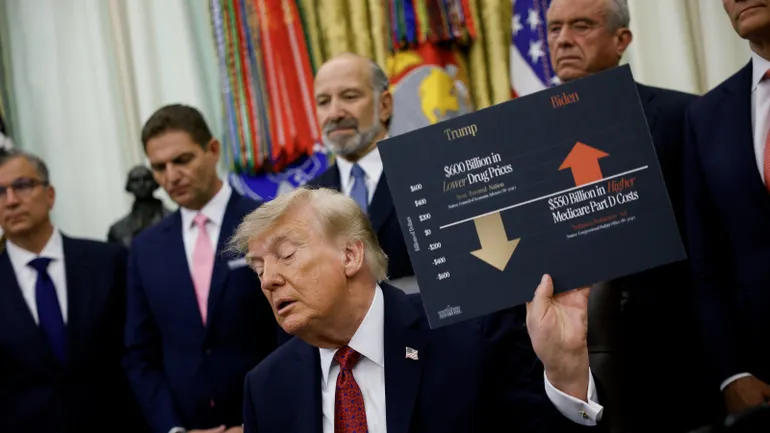
President Donald Trump’s "most-favored-nation" (MFN) agreements with pharmaceutical companies, purportedly designed to curb drug prices and reduce federal drug spending, may inadvertently undermine other substantial cost-reduction initiatives planned for the government. Specifically, these MFN deals could drastically diminish projected Medicare savings by nearly 80%, according to an updated analysis from a lead author of a Mass General Brigham study. This revelation introduces a significant layer of complexity and potential conflict into the administration’s multifaceted approach to tackling prescription drug costs, raising questions about the ultimate efficacy and coordination of these efforts.
Background: The Quest for Lower Drug Prices in the U.S.
The United States has long grappled with the highest prescription drug prices globally, a persistent issue that has fueled public discontent and driven various policy proposals across administrations. Unlike many developed nations where government bodies directly negotiate drug prices or link them to health technology assessments, the U.S. system relies on a complex interplay of manufacturers, insurers, pharmacy benefit managers (PBMs), and pharmacies, often resulting in opaque pricing structures. This environment has consistently prompted calls for reform, with different presidential administrations attempting to address the issue through a variety of mechanisms, from promoting generic competition to advocating for international reference pricing.
The concept of "most-favored-nation" pricing, traditionally applied in international trade agreements to ensure fair tariffs and trade practices among partners, has been adapted by the Trump administration as a strategy to address pharmaceutical costs. In this context, MFN drug deals aim to peg U.S. drug prices to the lower prices paid in other developed nations, thereby theoretically leveraging international benchmarks to reduce domestic expenditures. This approach aligns with a broader sentiment that American consumers should not pay significantly more for medications than their counterparts in other wealthy countries.
The White House’s MFN Initiatives: A Chronology of Deals
Over the past year, the White House has actively pursued and announced MFN agreements with a growing number of pharmaceutical manufacturers. These deals represent a direct engagement strategy, bypassing traditional legislative or regulatory processes in some instances. The initiative gained significant momentum following a May 2025 executive order from the White House, which explicitly directed federal health officials to align American drug costs with those prevalent in comparable nations.
To date, the administration has finalized MFN agreements with 26 pharmaceutical companies. The most recent wave of these agreements, announced in August 2026, involved nine mid-size firms. According to White House statements, these companies committed to offering state Medicaid programs prices tied to the costs paid in other developed nations. Beyond direct price reductions, the White House also indicated that participating companies agreed to apply MFN pricing to new medications entering the market and to reduce prices on certain high-cost therapies already in use. Some drugmakers additionally pledged to contribute critical medicines to national stockpiles or invest in enhancing U.S. pharmaceutical manufacturing capabilities, presenting these agreements as comprehensive efforts to bolster national health security and economic interests alongside cost reduction.
However, a key characteristic of these White House-led MFN deals is their confidentiality. The exact details of the agreements, including the specific drugs covered and the precise pricing mechanisms, are not publicly disclosed. This lack of transparency has made it challenging to ascertain the actual additional savings these agreements will generate for Medicaid. It is important to note that Medicaid programs already benefit from substantial drug discounts due to their significant purchasing power and statutory requirements. Furthermore, these Medicaid-focused pricing commitments do not directly influence what commercial insurers, who cover the majority of American citizens, pay for existing medications, limiting their immediate impact on a broad segment of the population.
The Medicare Conflict: GLOBE and GUARD Payment Models
Simultaneously, the federal government, through the Centers for Medicare & Medicaid Services (CMS), has been developing two separate, comprehensive Medicare MFN payment models: the Global Benchmark for Efficient Drug Pricing (GLOBE) and Guarding U.S. Medicare Against Rising Drug Costs (GUARD). These proposed models were conceived directly in response to the May 2025 executive order, aiming to implement a systematic approach to link U.S. drug prices to those in a basket of reference countries for Medicare Part B (physician-administered drugs) and Medicare Part D (prescription drugs, primarily retail).
Under the proposed rules, the GLOBE Model for Medicare Part B was slated to launch on October 1, and the GUARD Model for Medicare Part D on January 1, 2027. However, these plans have not yet been finalized, and their implementation faces potential hurdles. Experts in health policy and law have indicated that if implemented as proposed, these programs could face significant legal challenges from pharmaceutical companies and industry groups, who may argue against their statutory authority or constitutional validity.
Despite these potential legal battles, the projected savings from the GLOBE and GUARD models are substantial. A study published in The Lancet estimated that these programs, in their initial phase, could save Medicare an estimated $11.6 billion annually in net drug spending. This represents a significant reduction, projected to be between 16% and 18% of the relevant Medicare drug expenditures, offering a clear pathway to considerable federal savings and potentially lower costs for Medicare beneficiaries.
The Clash: MFN Deals vs. Medicare Savings
The core conflict arises from the belief among some drugmakers that their direct MFN agreements with the White House exempt them from participation in the proposed GLOBE and GUARD Medicare models. While the federal government has not yet publicly specified which companies, if any, will be exempt from these Medicare programs due to their separate White House agreements, pharmaceutical firms have begun to disclose their interpretations in financial filings and other public statements.
Dr. Thomas Hwang, the lead author of the Lancet study and a prominent researcher with Mass General Brigham, elaborated on this critical point. "Our secondary analysis – looking at the impact on savings from exempting companies – was based on companies’ financial filings and other disclosures that they believe their agreements exempt them from GLOBE/GUARD," Dr. Hwang stated via email. This analysis, he emphasized, reveals a profound financial implication: excluding these companies from the Medicare models would eliminate a substantial portion of the projected savings. The Mass General Brigham study’s updated estimate indicates that this exemption could reduce the anticipated Medicare savings by nearly 80%, transforming a potential multi-billion-dollar reduction into a significantly smaller figure.
This situation presents a complex policy dilemma. On one hand, the White House’s direct MFN deals are framed as immediate, executive-led actions to secure lower drug prices. On the other, the CMS-developed GLOBE and GUARD models represent a more systematic, reference-pricing approach aimed at broad Medicare savings. If the direct deals undermine the larger, more structured Medicare initiatives, the overall impact on federal drug spending could be far less than initially envisioned, raising questions about strategic coherence and the most effective path to sustainable drug cost reduction.
Complexity as a Barrier to Savings
The potential exemptions from GLOBE and GUARD are not the sole complicating factor in assessing the true impact of the MFN agreements on Americans’ drug spending. The American healthcare system is notoriously intricate, characterized by a dense web of pre-existing contractual agreements among manufacturers, insurers, pharmacy benefit managers (PBMs), and pharmacies. These agreements dictate drug prices, rebates, and formularies in a highly interconnected and often opaque manner.
Paul Pruitt, chief growth officer of SHARx, a prescription advocacy and procurement program, underscored this complexity. "All of pharma seems to have these long-term contractual agreements with the government programs and the commercial markets, and they’re all intertwined and interconnected in a very challenging way that is not easy to unwind," he explained. This intricate ecosystem means that simply lowering a manufacturer’s list price does not automatically translate into lower out-of-pocket costs for patients at the pharmacy counter. PBMs and insurers often negotiate their own discounts and rebates, and these savings may not always be passed directly to consumers.
TrumpRx and the Limitations of Direct-to-Consumer Discounts
In parallel with the MFN deals, the Trump administration has also promoted TrumpRx, a platform designed to offer direct-to-consumer discounts on prescription medications. Some pharmaceutical companies have agreed to sell their drugs at lower prices through TrumpRx as part of their MFN agreements, presenting it as a direct avenue for patient savings. However, the effectiveness and reach of TrumpRx have also come under scrutiny.
One significant limitation is that TrumpRx primarily offers cash-pay discounts, operating largely outside traditional insurance frameworks. This means it may provide less value to patients who already have insurance coverage that offers lower out-of-pocket prices through co-pays or deductibles, especially if their plans have robust formulary coverage.
Furthermore, the scope of drugs available through TrumpRx is relatively limited. An analysis conducted by NPR in mid-July indicated that only 92 brand-name drugs were listed on the platform, representing a mere 12% of the 800 brand-name drugs produced by participating companies. For instance, Pfizer, a major pharmaceutical player, listed only 30 of its 178 branded drugs on TrumpRx. Critics also point out that some drugs available on the platform have existing generic alternatives that are often significantly less expensive, potentially diminishing the perceived value of the TrumpRx discount for those specific medications. These factors collectively suggest that while TrumpRx might offer some relief for specific uninsured or underinsured patients, its overall impact on broad consumer savings remains constrained.
Broader Implications and Future Outlook
The unfolding situation highlights a fundamental challenge in U.S. drug pricing policy: the difficulty of implementing effective, comprehensive reforms in a fragmented and heavily lobbied environment. The conflict between the White House’s direct MFN deals and CMS’s proposed systematic Medicare models underscores the lack of a unified strategy, potentially leading to unintended consequences and reduced overall impact.
From a pharmaceutical industry perspective, analysts have generally predicted that the White House MFN deals will have a relatively minor financial impact on drug companies. The limited scope, confidentiality, and potential for exemptions from broader Medicare models mean that the industry may face less pressure than initially suggested by the administration’s rhetoric. This also implies that the "dent" in drug spending for federal programs, and substantial savings for consumers at the pharmacy counter, may not materialize to the extent desired or promised.
The legal challenges anticipated for the GLOBE and GUARD models further complicate the landscape. If these models are stalled or struck down by courts, the administration’s most ambitious systematic drug pricing reforms could fail to launch, leaving the more limited MFN deals as the primary, albeit less impactful, legacy of its drug pricing efforts.
Ultimately, the effectiveness of the Trump administration’s MFN drug pricing initiatives in achieving their stated goals of significantly lowering drug prices and slashing federal drug spending remains uncertain. The intricate nature of the U.S. healthcare system, the confidential terms of the direct deals, the potential for exemptions from more comprehensive Medicare reforms, and the limited reach of direct-to-consumer platforms like TrumpRx all contribute to a complex picture where projected savings are at risk of being substantially diminished. As the nation continues to grapple with high prescription drug costs, the outcomes of these various strategies will be closely watched by policymakers, industry stakeholders, and, most importantly, American patients.
