
 By admin
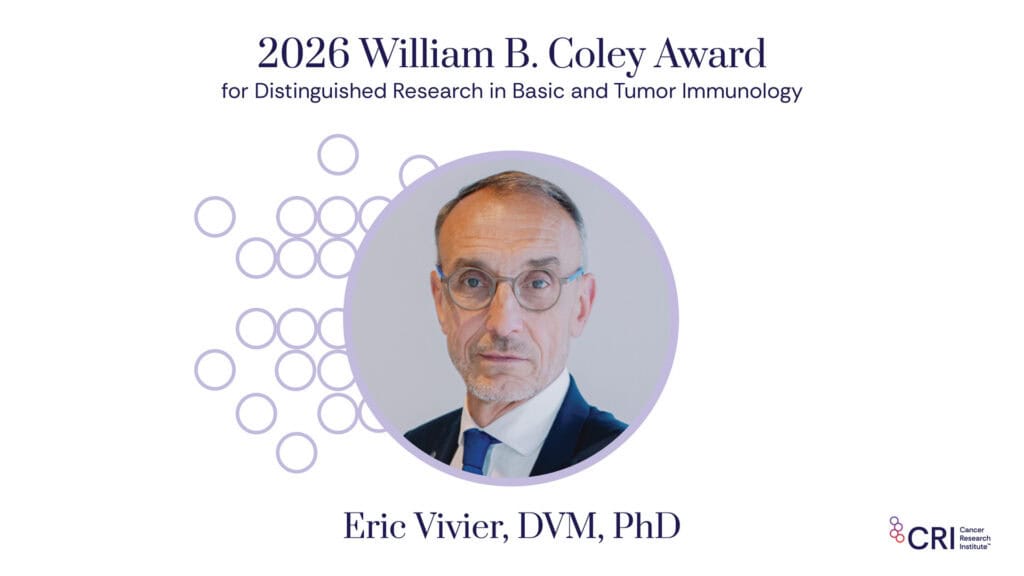
New York, NY – The Cancer Research Institute (CRI), a global leader in advancing immunotherapy research, proudly announced the recipients of its esteemed 2026 Scientific Achievement Awards, recognizing two pioneering immunologists whose work has fundamentally reshaped our understanding of the immune system’s role in fighting cancer. Dr. Eric Vivier, DVM, PhD, a distinguished Professor of Immunology at Marseille Medical School and head of the Innate Lymphoid Cells laboratory at the Centre d’Immunologie de Marseille-Luminy, has been awarded the prestigious William B. Coley Award for Distinguished Research in Basic and Tumor Immunology. Concurrently, Dr. Joseph Sun, PhD, a prominent Member of the Immunology Program at Memorial Sloan Kettering Cancer Center and Professor and Director of the Immunology and Microbial Pathogenesis Program at Weill Cornell Medical College, is the recipient of the Frederick W. Alt Award for New Discoveries in Immunology. These accolades underscore CRI’s commitment to recognizing groundbreaking scientific inquiry that propels the field of cancer immunotherapy forward, offering new hope in the global fight against cancer, a disease projected to claim over 10 million lives annually worldwide.
The highly anticipated awards will be formally presented at CRI’s Annual Awards Gala, a cornerstone event in the biomedical calendar, scheduled for Tuesday, October 20, 2026, at the iconic Guastavino’s in New York City. This elegant affair brings together leading scientists, philanthropists, and industry pioneers to celebrate scientific excellence and galvanize support for continued research. Further details regarding the gala, including keynote speakers and special presentations, are expected to be unveiled in the coming weeks.
A Legacy of Immunological Breakthroughs: The William B. Coley Award
The William B. Coley Award, named in honor of the "Father of Immunotherapy," Dr. William B. Coley (1862-1936), recognizes scientists who have made seminal discoveries in basic and tumor immunology, paralleling Coley’s early, audacious attempts to harness the immune system to combat cancer in the late 19th and early 20th centuries. Coley’s pioneering work with "Coley’s Toxins," a bacterial mixture used to stimulate an immune response against tumors, laid the foundational groundwork for modern immunotherapy. The award celebrates researchers whose work exemplifies this pioneering spirit and has significantly advanced our understanding of immune mechanisms in cancer. Past recipients represent a pantheon of immunology, many of whom have gone on to receive further international recognition, including Nobel Prizes, cementing the award’s reputation as a harbinger of future scientific acclaim.
Dr. Eric Vivier’s selection for the 2026 Coley Award acknowledges his profound and sustained contributions to the field of innate immunity, particularly his seminal work on natural killer (NK) cells. NK cells, a critical component of the innate immune system, serve as the body’s rapid-response team, capable of identifying and eliminating infected or cancerous cells without prior sensitization. Dr. Vivier’s research has been instrumental in elucidating the intricate mechanisms by which NK cells recognize malignant cells and how these cells interact with the broader immune microenvironment. His laboratory’s breakthroughs have not only deepened the fundamental understanding of innate lymphoid cells (ILCs) but have also established innate immunity as a crucial pillar in the development of contemporary cancer immunotherapies.
Beyond his fundamental research, Dr. Vivier has been a pivotal figure in translating scientific discoveries into clinical applications. As a co-founder of Innate Pharma, a leading biotechnology company focused on developing first-in-class innate immunity therapeutics, his leadership has directly facilitated the advancement of novel immunotherapeutic strategies from the laboratory bench to patient care. This translational impact underscores the profound real-world implications of his work. Dr. Vivier’s exceptional scientific career is further highlighted by his consistent recognition as a Highly Cited Researcher since 2015, alongside numerous other accolades, including election to the prestigious French National Academy of Medicine and EMBO, and several of France’s highest civilian distinctions. His work stands as a testament to the power of basic research to unlock new therapeutic paradigms, offering tangible hope for patients facing challenging cancers.
In addition to receiving his award at the gala, Dr. Vivier is slated to deliver the highly anticipated 2026 Coley Lecture at the Society for Immunotherapy of Cancer (SITC) Annual Meeting. This prominent gathering of leading cancer immunologists, clinicians, and industry representatives will take place from November 4-8, 2026, in Phoenix, Arizona. Dr. Vivier’s lecture, scheduled for Sunday, November 8, is expected to provide a comprehensive overview of his pioneering research and its enduring impact on the field, offering insights into the future directions of innate immunity-based cancer treatments. The SITC meeting serves as a crucial platform for disseminating the latest research, fostering collaborations, and accelerating the development of immunotherapeutic interventions.
Illuminating New Frontiers: The Frederick W. Alt Award
The Frederick W. Alt Award for New Discoveries in Immunology celebrates early-to-mid-career scientists who have made exceptionally creative and impactful discoveries in immunology, particularly those that challenge existing paradigms or open entirely new avenues of research. The award honors Dr. Frederick W. Alt, a distinguished scientist whose groundbreaking work on genetic recombination and genome stability has had profound implications for immunology and cancer biology. The award aims to identify and foster the next generation of scientific trailblazers whose insights promise to revolutionize our understanding of the immune system.
Dr. Joseph Sun is being recognized with the 2026 Frederick W. Alt Award for his transformative discoveries concerning immunological memory, a concept traditionally associated exclusively with the adaptive immune system (T cells and B cells). Dr. Sun’s groundbreaking research has fundamentally reshaped our understanding of how the immune system "remembers" past encounters, revealing that components of the innate immune system, specifically NK cells, also exhibit features of adaptive memory. This paradigm-shifting insight has profound implications for vaccine development, infectious disease control, and, crucially, cancer immunotherapy.
A testament to the CRI’s role in nurturing scientific talent, Dr. Sun’s pivotal work began during his tenure as a CRI Irvington Postdoctoral Fellow from 2007 to 2009, working in the laboratory of Dr. Lewis Lanier, PhD, at the University of California, San Francisco (UCSF). It was during this fellowship that Dr. Sun made the remarkable discovery that NK cells could undergo clonal expansion and develop long-lived memory following viral infection. This finding challenged the long-held dogma that adaptive immune features were exclusive to T and B lymphocytes, blurring the lines between the innate and adaptive branches of immunity.
Dr. Sun’s subsequent research has continued to illuminate the molecular pathways and cellular mechanisms that drive immune memory in the context of both infection and cancer. By uncovering how these memory responses are generated and maintained, his work provides critical insights that are directly informing the design of next-generation immunotherapies. Understanding how NK cells can be trained to "remember" and more effectively target cancer cells opens up exciting possibilities for developing more potent and durable anti-cancer treatments.
Dr. Lewis Lanier, a revered Member of CRI’s Scientific Advisory Council and Dr. Sun’s former postdoctoral mentor, eloquently praised his former trainee: “Dr. Sun has been an absolute leader in his field, and I’m so happy that we’re going to acknowledge him as being one of the superstars that launched their careers with his CRI Irvington Fellowship.” This sentiment highlights the significant impact of CRI’s fellowship programs in identifying and supporting brilliant young scientists who go on to make transformative contributions to immunology and cancer research.
The Broader Impact: Reshaping Cancer Immunotherapy
The collective work of Dr. Vivier and Dr. Sun epitomizes the dynamic and rapidly evolving landscape of cancer immunotherapy. Cancer remains a formidable global health challenge, with the World Health Organization estimating that it is the second leading cause of death globally, responsible for nearly one in six deaths. While traditional treatments like chemotherapy, radiation, and surgery have long been the mainstays, immunotherapy has emerged as a revolutionary fourth pillar of cancer treatment, offering unprecedented success rates for certain hard-to-treat cancers and providing durable remissions for many patients.
The discoveries recognized by the CRI’s 2026 Scientific Achievement Awards are not merely academic achievements; they represent fundamental shifts in our understanding that have direct translational potential. Dr. Vivier’s work on NK cells and innate immunity provides a deeper appreciation for the immune system’s immediate response mechanisms against cancer. This knowledge is crucial for developing therapies that can either directly activate NK cells or modify the tumor microenvironment to enhance their anti-tumor activity. His leadership in biotechnology ensures that these insights are rapidly translated into clinical trials, potentially yielding new drug candidates that leverage the innate immune system.
Similarly, Dr. Sun’s groundbreaking demonstration of adaptive-like memory in NK cells has opened up entirely new avenues for therapeutic development. If NK cells can be "primed" or "trained" to remember specific tumor antigens, they could potentially be harnessed for long-lasting anti-cancer immunity, akin to how vaccines protect against infectious diseases. This concept is particularly exciting for preventing cancer recurrence, a major challenge in oncology, and for developing off-the-shelf cellular therapies that are more accessible and versatile than current personalized approaches. The implications extend beyond cancer, potentially influencing strategies for chronic viral infections and autoimmune diseases.
These scientists, through their independent yet complementary research, have expanded our understanding of immune cell biology in unprecedented ways. They have challenged conventional wisdom, revealing a more interconnected and versatile immune system than previously imagined. Their work provides the foundational knowledge necessary to overcome current limitations in immunotherapy, such as resistance to checkpoint blockade therapies or the need for more effective treatments for "cold" tumors that lack immune infiltration. By elucidating the fundamental mechanisms of immune recognition, activation, and memory, Dr. Vivier and Dr. Sun are paving the way for a new generation of immunotherapies that are more effective, durable, and broadly applicable.
The Cancer Research Institute, through its unwavering support for cutting-edge research and its recognition of scientific excellence, continues to play a vital role in accelerating progress in cancer immunotherapy. The 2026 Scientific Achievement Awards not only celebrate the remarkable achievements of Dr. Eric Vivier and Dr. Joseph Sun but also symbolize the collective hope and relentless pursuit of a future free from the burden of cancer, driven by the power of the immune system. The upcoming gala and the Coley Lecture at SITC will serve as crucial platforms to further disseminate these pivotal discoveries and inspire the next wave of scientific innovation in this transformative field.
