
 By admin
The narrative of childhood cancer is often defined by clinical milestones and survival statistics, yet for the family of Jaylen and Ayla, the journey has been equally defined by a fierce battle for equitable healthcare access. Jaylen, now 10, and his sister Ayla, 8, are both survivors of hereditary bilateral retinoblastoma, a rare and aggressive form of eye cancer. Their path to remission was complicated not only by the physiological demands of the disease but by systemic barriers within the medical establishment that initially hindered their mother’s ability to secure timely care. Today, as both children thrive with prosthetic eyes and a renewed lease on life, their story serves as a critical case study in the importance of early detection, the complexities of hereditary genetic conditions, and the indispensable role of parental advocacy in the face of disability-based discrimination.
Early Indicators and the Challenge of Medical Access
The diagnostic journey began nearly a decade ago when Jaylen was just two months old. His mother, Denice, noticed a subtle but persistent deviation in his left eye, which appeared to veer outward—a condition clinically known as strabismus. While family photographs from that period captured a distinct "glow" or white reflection in Jaylen’s pupil, the family initially attributed the phenomenon to camera flash and ambient lighting. This "glow," or leukocoria, is a hallmark clinical sign of retinoblastoma, occurring when a tumor at the back of the eye reflects light rather than absorbing it.
The urgency of the situation escalated when Jaylen reached his four-month check-up. Denice, who is Deaf, sought professional medical evaluation for her son’s ocular symptoms. However, the family encountered a significant systemic hurdle: the medical provider refused to see them, citing the lack of an American Sign Language (ASL) interpreter on-site. This refusal represented a breach of the Americans with Disabilities Act (ADA), which mandates that healthcare providers ensure effective communication with patients and their companions through auxiliary aids, including qualified interpreters.
Undeterred by the medical system’s failure to provide accessible care, Denice initiated an independent search for a provider willing to accommodate her needs and evaluate her son. This delay in care is a recurring theme in pediatric oncology cases involving marginalized or disabled parents, where administrative barriers can lead to dangerous postponements in diagnosis. Eventually, Denice secured an appointment with a specialist who confirmed the devastating diagnosis: Jaylen had bilateral retinoblastoma, meaning tumors were present in both eyes.
The Genetic Component: Hereditary Bilateral Retinoblastoma
Retinoblastoma is a rare cancer of the retina that affects approximately one in 15,000 to 20,000 live births. It is caused by a mutation in the RB1 gene. While many cases are sporadic, affecting only one eye (unilateral), bilateral cases are almost exclusively hereditary. In hereditary retinoblastoma, the child inherits a germline mutation from a parent or develops a new mutation in the early stages of fetal development. This genetic predisposition means that every cell in the child’s body carries the mutation, making the development of tumors in both eyes highly likely.
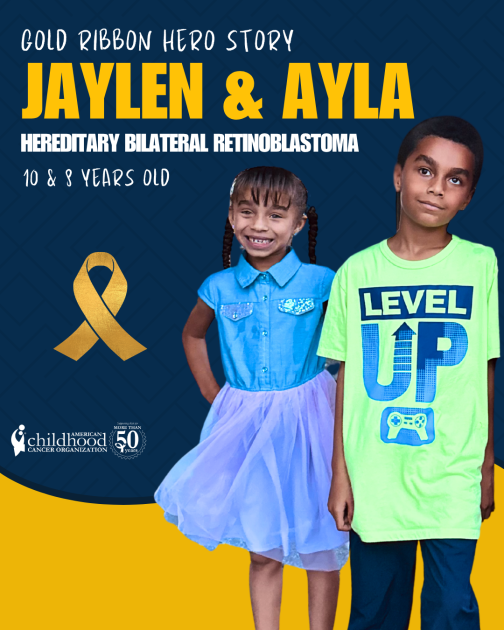
Because Jaylen’s condition was confirmed as hereditary, the medical team knew that any future siblings would be at an exceptionally high risk. When Ayla was born two years later, she was placed under immediate and rigorous ophthalmic surveillance. This proactive monitoring allowed doctors to detect tumors in her eyes when she was just four weeks old. While the news of a second child with cancer was emotionally taxing for the family, the early detection—made possible by the knowledge gained from Jaylen’s diagnosis—was a critical factor in her treatment prognosis.
A Decade of Intensive Treatment Modalities
The treatment of bilateral retinoblastoma is a complex, multi-year process aimed at three primary goals: saving the child’s life, preserving the eye, and maintaining as much vision as possible. For Jaylen and Ayla, the clinical path involved a grueling combination of systemic and localized therapies.
Over the years, both children underwent systemic chemotherapy to shrink the tumors. This was supplemented by focal therapies, including cryotherapy—a process that uses extreme cold to freeze and destroy cancer cells—and laser photocoagulation, which uses heat to cut off the blood supply to the tumors. Jaylen also required strabismus surgery to correct the alignment of his eyes, a common necessity when tumors affect the ocular muscles or visual focus.
Despite the best efforts of their oncology teams, the aggressive nature of the cancer necessitated surgical intervention for Ayla. She underwent an enucleation, the surgical removal of the eye, to prevent the cancer from spreading through the optic nerve to the brain. Following the procedure, Ayla was fitted with a prosthetic eye. Jaylen also eventually transitioned to life with a prosthetic. The adaptation to ocular prosthetics is both a physical and psychological journey, requiring regular fittings as the child grows and a shift in how they perceive their own identity and appearance.
Advocacy as a Clinical Necessity
Denice’s experience highlights a critical intersection between healthcare and disability rights. Reflecting on the early days of Jaylen’s diagnosis, she described the experience as a combination of heartbreak and profound anger. The frustration of being turned away by a medical provider while her infant son had undiagnosed cancer fueled a shift in her perspective. She transitioned from a worried parent to what she describes as the "ultimate advocate and manager" of her children’s health.
This advocacy was not limited to the clinical setting. As Denice shared her family’s journey online to raise awareness about retinoblastoma and the "glow," she encountered the complexities of public scrutiny. Despite criticism regarding her parenting choices and the decision to "spoil" her children, Denice has remained steadfast in her philosophy of "choosing joy." She emphasizes that surviving a life-threatening illness earns a family the right to live entirely in the present and celebrate every milestone with exuberance.
Current Status and Broader Implications
Today, Jaylen and Ayla are thriving. Their journey from diagnosis to remission is a testament to the efficacy of modern pediatric oncology, yet it also serves as a reminder of the long-term nature of cancer survivorship. Ayla, in particular, has embraced her prosthetic eye as a form of self-expression. She has curated a collection of custom-colored irises, allowing her to "swap her eyes" to match her style, a move that reclaims agency over a physical change forced upon her by illness.
The siblings are also active in the Deaf community. Ayla began learning ASL during her immediate post-operative recovery, ensuring that she can communicate fluently with her mother and navigate the world with the same fierce independence Denice demonstrated during the children’s treatment.
The broader implications of Jaylen and Ayla’s story are significant for the medical community and the public at large. First, it underscores the life-saving potential of recognizing the "white glow" in flash photography. Organizations like the American Childhood Cancer Organization (ACCO) continue to campaign for public awareness of leukocoria as a primary screening tool for parents.
Second, the case highlights the ongoing need for medical facilities to adhere to the ADA. The denial of care based on a parent’s disability is not only a legal violation but a public health risk that can delay life-saving cancer treatments. Ensuring that interpreters are available and that medical staff are trained in accessible communication is essential for equitable healthcare delivery.
Finally, the family’s story emphasizes the importance of genetic counseling for families with a history of retinoblastoma. Because the RB1 mutation can be passed to future generations, survivors of the hereditary form of the disease require lifelong monitoring, as they are at an increased risk for secondary cancers later in life, such as osteosarcoma or melanoma.
Conclusion
Jaylen and Ayla’s triumph over hereditary bilateral retinoblastoma is a narrative of medical success intertwined with social struggle. By overcoming the barriers of a complex genetic diagnosis and a discriminatory healthcare encounter, the family has emerged as a beacon of hope for others facing similar diagnoses. Their lives today—characterized by joy, style, and a commitment to advocacy—prove that a childhood cancer diagnosis does not define the limits of a child’s future. Instead, it highlights the necessity of a healthcare system that is as inclusive as it is technically proficient, and the power of a parent’s voice in ensuring that no child fights cancer alone.
