
 By Suherman Candra Maholtra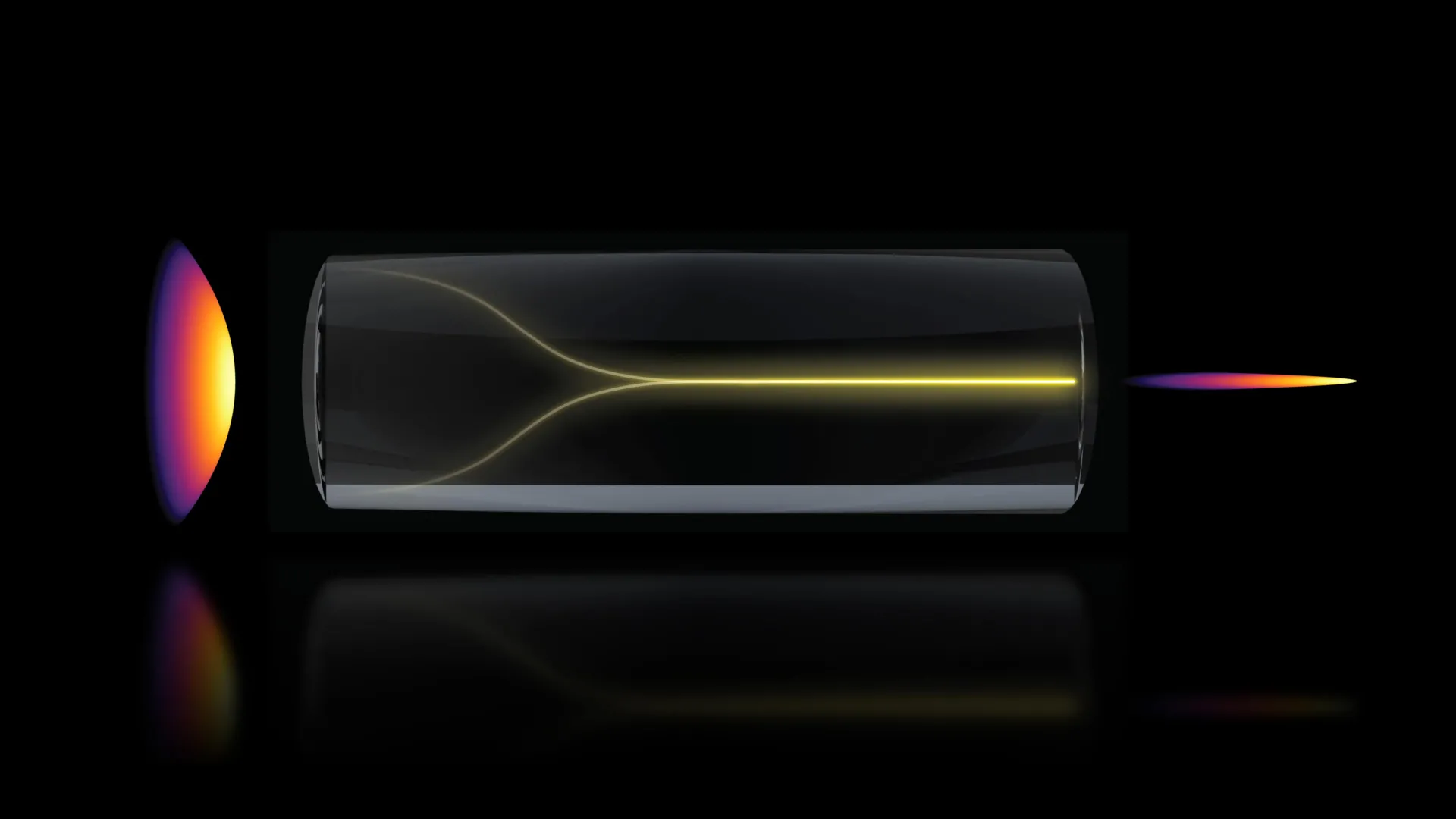
In a significant departure from established principles of optical physics, a research team at the Massachusetts Institute of Technology (MIT) has uncovered a phenomenon where chaotic laser signals, under specific high-power conditions, spontaneously reorganize into a highly focused "pencil beam." This discovery, detailed in a study published today in the journal Nature Methods, has immediate and transformative applications for medical imaging. By utilizing this self-formed beam, researchers have successfully produced 3D images of the human blood-brain barrier at speeds 25 times faster than current gold-standard techniques. The breakthrough allows for the real-time observation of individual cells as they absorb pharmaceutical compounds, providing a vital tool for evaluating the efficacy of treatments for neurodegenerative diseases such as Alzheimer’s and Amyotrophic Lateral Sclerosis (ALS).
The research was led by Sixian You, an assistant professor in MIT’s Department of Electrical Engineering and Computer Science (EECS) and a member of the Research Laboratory for Electronics. The team’s findings challenge the long-held assumption that increasing the power of a laser traveling through a disordered medium inevitably leads to increased entropy and chaotic scattering. Instead, the team demonstrated that when pushed to its limits, light can achieve a state of self-organization that simplifies complex bioimaging tasks.
The Mechanics of Self-Organizing Light
The journey toward this discovery began with an experiment that initially seemed destined for failure. Lead author Honghao Cao, an EECS graduate student, was working with a "fiber shaper"—a device designed by the team to control the path of laser light through multimode optical fibers. Multimode fibers are capable of carrying high levels of energy but are notoriously difficult to control because their internal structures cause light to bounce and scatter in unpredictable ways.
In standard optical procedures, researchers typically keep laser power low to avoid damaging the delicate glass fibers. However, while testing the physical limits of their setup, Cao gradually increased the power. According to conventional physics, this should have resulted in a "speckle pattern"—a disorganized, grainy distribution of light. Instead, as the power reached a critical threshold near the fiber’s damage point, the scattered light suddenly collapsed into a single, intense, and perfectly straight beam.
This "pencil beam" is the result of nonlinear optical effects. When the intensity of the light is sufficiently high, it begins to alter the refractive index of the glass fiber itself. This interaction creates a feedback loop where the light shapes the medium, and the medium, in turn, focuses the light. This nonlinearity effectively counters the intrinsic disorder of the fiber, creating a stable, ultrafast beam without the need for the expensive and cumbersome beam-shaping components usually required in high-end microscopy.
Overcoming the Resolution-Depth Tradeoff
One of the most persistent challenges in optical imaging is the inherent tradeoff between resolution and depth of focus. In traditional microscopy, a high-resolution image typically requires a very shallow depth of field, meaning only a thin "slice" of a sample can be in focus at any given time. To create a 3D image, researchers must take hundreds of these slices and stack them—a process that is both time-consuming and computationally expensive.
The self-organized pencil beam sidesteps this limitation. Because the beam remains narrow and focused over a much longer distance than conventional laser pulses, it can maintain high resolution across a significantly larger depth of focus. This allows the MIT system to capture comprehensive 3D data in a fraction of the time required by existing methods. In comparative tests, the team found that their approach could generate cellular-level 3D images with a 25-fold increase in speed, all while maintaining the clarity and detail of the current industry standards.
Furthermore, the pencil beam produced by this method is notably "cleaner" than those generated by traditional engineering. Conventional beams often suffer from "sidelobes"—secondary halos of light that blur the edges of an image and create artifacts. The self-organized beam naturally suppresses these sidelobes, resulting in sharper contrasts and more accurate representations of biological structures.
A Breakthrough for Blood-Brain Barrier Research
To demonstrate the practical utility of this technology, the MIT researchers applied it to the study of the human blood-brain barrier (BBB). The BBB is a highly selective semipermeable border of endothelial cells that prevents solutes in the circulating blood from non-selectively crossing into the extracellular fluid of the central nervous system. While this barrier is essential for protecting the brain from toxins and pathogens, it is also the primary obstacle in treating brain diseases, as it blocks the vast majority of therapeutic drugs.
The pharmaceutical industry has long struggled to find effective ways to track how drugs interact with the BBB. Current methods often require "tagging" drug molecules with fluorescent dyes to make them visible under a microscope. However, these tags can change the chemical properties of the drug, potentially altering how it crosses the barrier and rendering the test results inaccurate.
The MIT team’s new method is "label-free," meaning it can visualize proteins and pharmaceutical compounds without the need for fluorescent markers. By using the high-speed pencil beam, the researchers were able to track the entry of drugs into the brain in real-time and identify exactly which cell types were internalizing the compounds.
"The pharmaceutical industry is especially interested in using human-based models to screen for drugs that effectively cross the barrier, as animal models often fail to predict what happens in humans," said Roger Kamm, the Cecil and Ida Green Distinguished Professor of Biological and Mechanical Engineering at MIT and a co-author of the study. "For the first time, we can now visualize the time-dependent entry of drugs into the brain."
Chronology of the Discovery and Research Team
The development of this technique was the result of a multi-year collaborative effort involving experts in electrical engineering, biological engineering, and clinical medicine. The timeline of the project highlights the role of serendipity in scientific advancement:
- Phase 1 (Initial Development): The team developed a custom fiber shaper to experiment with multimode fibers, seeking better ways to transmit high-power light for industrial applications.
- Phase 2 (The Observation): During stress tests of the fiber, Honghao Cao observed the unexpected transition from a scattered signal to a focused beam at high power levels.
- Phase 3 (Theoretical Validation): The team spent several months identifying the two necessary conditions for the effect: a strict zero-degree entry angle and a specific power threshold that triggers nonlinearity in the glass.
- Phase 4 (Biological Testing): In collaboration with researchers from Harvard University and Beth Israel Deaconess Medical Center, the team applied the beam to engineered models of the human blood-brain barrier.
- Phase 5 (Publication): The findings were peer-reviewed and published in Nature Methods on December 11, 2024.
The lead author, Honghao Cao, was supported by a diverse group of researchers, including EECS graduate students Li-Yu Yu and Kunzan Liu; postdocs Sarah Spitz, Francesca Michela Pramotton, and Federico Presutti; and Subhash Kulkarni, an assistant professor at Harvard University.
Broader Implications for Biological Engineering
While the blood-brain barrier served as the primary test case, the implications of this technology extend far beyond neuropharmacology. The ability to perform high-speed, label-free 3D imaging could revolutionize several fields of biological engineering and clinical diagnostics.
Sarah Spitz, a postdoc at MIT and co-author of the paper, noted that the approach enables the time-resolved tracking of diverse compounds across various engineered tissue models. This could include monitoring how nutrients are absorbed in the gut, how cancer cells respond to chemotherapy in a tumor microenvironment, or how synthetic tissues integrate with host cells in regenerative medicine.
From a practical standpoint, the "charm" of the method—as described by Professor You—is its accessibility. Because the beam organizes itself, it does not require the specialized, expensive optical hardware typically needed for advanced microscopy. This could democratize high-end imaging, allowing smaller labs and clinics to perform sophisticated biological analysis without the need for extensive domain expertise in optical physics.
Future Outlook and Next Steps
The MIT team is now looking toward the next phase of their research, which involves two primary goals. First, they intend to delve deeper into the fundamental physics of the self-organizing beam. While they have identified the conditions necessary for its formation, the exact sub-atomic interactions between the photons and the fiber’s molecular structure remain a subject for further study.
Second, the researchers plan to adapt the technology for imaging neurons in vivo. Mapping the firing patterns of neurons in three dimensions has been a "holy grail" of neuroscience, but it is currently limited by the same speed-resolution tradeoffs that the pencil beam appears to solve. If successful, this could lead to new insights into how the brain processes information and how those processes break down in psychiatric and neurological disorders.
The study received financial support from several prestigious organizations, including the National Science Foundation (NSF), the Silicon Valley Community Foundation, the Diacomp Foundation, and the Harvard Digestive Disease Core. Additional support was provided by the Claude E. Shannon Award and a MathWorks Fellowship.
As the medical community continues to seek faster and more accurate ways to bridge the gap between drug discovery and clinical application, the MIT team’s discovery of self-organizing light offers a powerful new tool. By turning the "hassle" of optical disorder into a solution, they have opened a new window into the microscopic workings of the human body.
