
 By Gabriel Paijo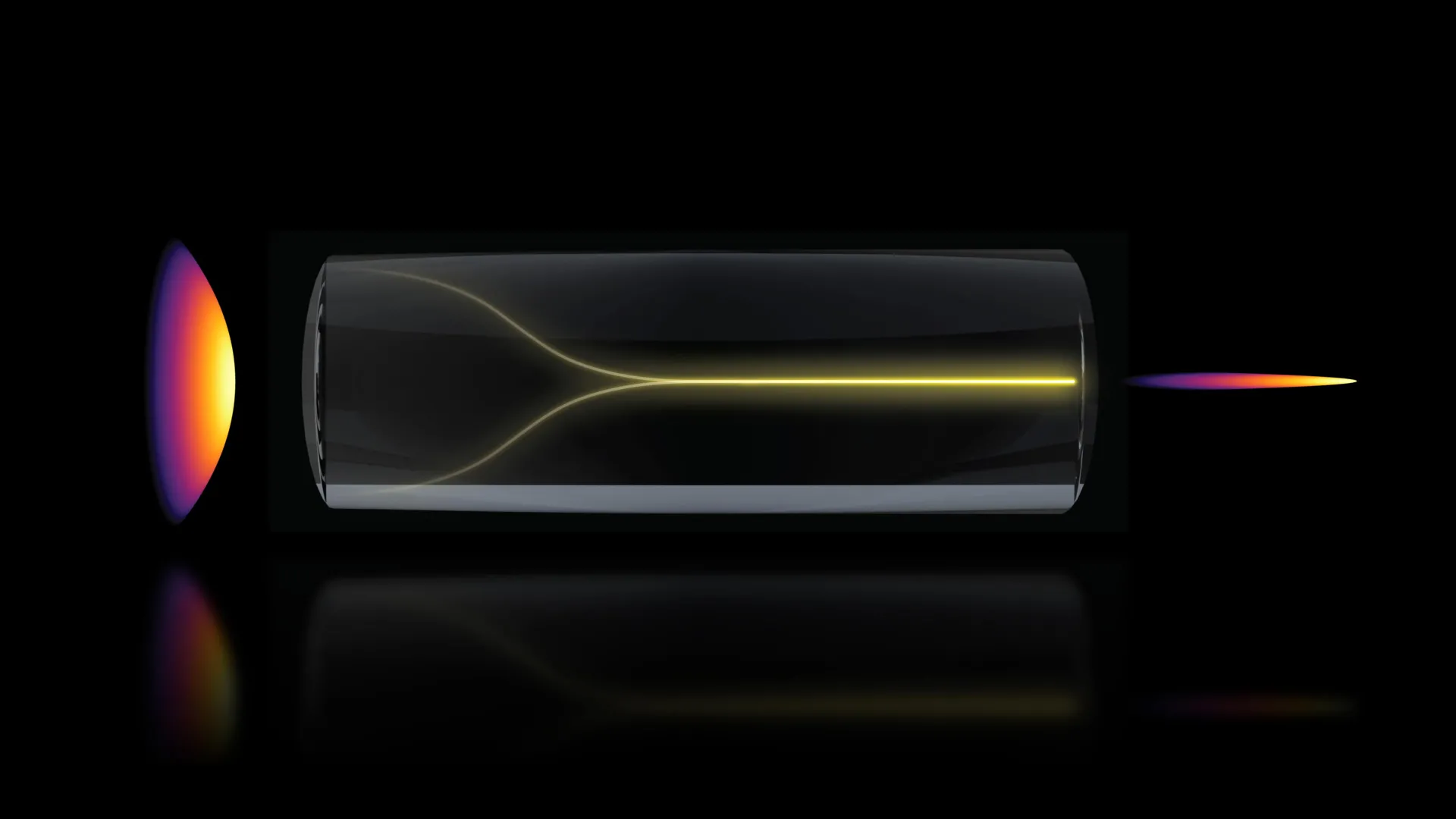
In a significant departure from long-standing principles in optical physics, a research team at the Massachusetts Institute of Technology (MIT) has discovered a method to transform chaotic, scattered laser signals into a highly organized, narrow "pencil beam." This breakthrough, detailed in a recent publication in the journal Nature Methods, offers a transformative approach to medical imaging, particularly for the visualization of complex biological structures like the human blood-brain barrier. By harnessing this self-organizing light effect, researchers have successfully produced 3D images of living tissue at speeds approximately 25 times faster than current gold-standard techniques, all while maintaining high resolution and eliminating the need for invasive fluorescent tags.
The discovery challenges the conventional wisdom that increasing laser power within an optical fiber inevitably leads to increased disorder and thermal noise. Instead, the MIT team demonstrated that under specific, controlled conditions, light can undergo a phase of self-correction, resulting in a stable and ultra-focused beam. This advancement holds profound implications for the pharmaceutical industry and neurodegenerative disease research, providing a real-time window into how drugs interact with individual cells in the brain—a process that has historically been difficult to observe without damaging the specimen or relying on inaccurate animal models.
The Mechanics of Self-Organizing Light
To understand the magnitude of this discovery, one must first consider the inherent challenges of multimode optical fibers. These fibers are designed to carry large amounts of data or high levels of power across multiple paths, or "modes." However, because of microscopic imperfections and the nature of light propagation, these modes typically interfere with one another, causing the output to appear as a scattered, "speckle" pattern rather than a clean beam. Traditionally, overcoming this disorder requires complex beam-shaping hardware and sophisticated algorithms to reconstruct a usable image.
The MIT team, led by Sixian You, an assistant professor in the Department of Electrical Engineering and Computer Science (EECS), and lead author Honghao Cao, an EECS graduate student, found that they could bypass this complexity by pushing the fiber to its physical limits. Using a custom-built "fiber shaper," the researchers began increasing the laser power to see how the fiber would respond near its damage threshold.
Contrary to expectations, as the power reached a critical level, the scattered light began to reorganize. The "nonlinearity" of the glass—a phenomenon where the material’s properties change in response to the intensity of the light—began to counter the intrinsic disorder of the fiber. The result was the emergence of a stable "pencil beam" that emerged from the fiber without the need for external correction. This self-formation represents a rare instance where high-energy input leads to greater order rather than entropy.
Critical Conditions for Beam Formation
The research team identified two rigorous requirements for achieving this self-organizing state. First, the laser must be injected into the multimode fiber at a perfectly aligned, zero-degree angle. While standard optical practices allow for some margin of error in alignment, this technique demands absolute precision to ensure the light modes interact correctly.
Second, the power must be elevated to a specific threshold where the light begins to interact directly with the molecular structure of the glass fiber. At this juncture, the nonlinear effects become strong enough to suppress the scattering. This "critical power" creates a balance that focuses the energy into a single, sharp point.
"Disorder is intrinsic to these fibers," explained Professor You. "The light engineering you typically need to do to overcome that disorder, especially at high power, is a longstanding hassle. But with this self-organization, you can get a stable, ultrafast pencil beam without the need for custom beam-shaping components."
This simplicity is one of the method’s most significant advantages. Because the beam organizes itself through the physics of the fiber rather than through external computer processing or complex lenses, the setup is accessible to researchers who may not have deep expertise in specialized optical engineering.
High-Speed 3D Imaging of the Blood-Brain Barrier
The primary application for this new imaging technique is the study of the human blood-brain barrier (BBB). The BBB is a highly selective semipermeable border of endothelial cells that prevents solutes in the circulating blood from non-selectively crossing into the extracellular fluid of the central nervous system. While this barrier is essential for protecting the brain from toxins and pathogens, it also serves as a formidable obstacle for drug delivery.
Current methods for imaging the BBB in 3D often involve taking multiple 2D "slices" and stitching them together, a process that is time-consuming and often fails to capture the dynamic movement of molecules in real time. The MIT team’s pencil beam approach allows for a much larger "depth of focus" while maintaining high resolution. This means the system can scan through layers of tissue much faster than traditional systems.
In laboratory tests, the team used the self-organized beam to image engineered human BBB models. They were able to track the movement of proteins and drug compounds as they were absorbed by individual cells. The system operated 25 times faster than existing gold-standard multiphoton microscopy techniques. Furthermore, the images were free from "sidelobes"—the blurred halos that often haunt high-intensity laser imaging—resulting in a cleaner, more accurate representation of cellular architecture.
Implications for Drug Development and Neurodegenerative Disease
The ability to watch individual cells internalize drugs in real-time, without the use of fluorescent labels, is a major milestone for biomedical engineering. Many drugs intended to treat conditions such as Alzheimer’s disease, Amyotrophic Lateral Sclerosis (ALS), and Parkinson’s disease fail in clinical trials because they cannot effectively penetrate the BBB.
Historically, the pharmaceutical industry has relied on animal models to test BBB permeability. However, animal physiology often fails to accurately predict human responses. The new MIT method allows researchers to use human-based engineered tissue models—often referred to as "organs-on-a-chip"—to see exactly how a drug behaves.
Roger Kamm, the Cecil and Ida Green Distinguished Professor of Biological and Mechanical Engineering at MIT and a collaborator on the study, emphasized the importance of this label-free approach. "The pharmaceutical industry is especially interested in using human-based models to screen for drugs… That this new method doesn’t require the cells to have a fluorescent tag is a game-changer. For the first time, we can now visualize the time-dependent entry of drugs into the brain and even identify the rate at which specific cell types internalize the drug."
By removing the need for fluorescent tags, researchers avoid the risk of the tags themselves altering the behavior or chemical properties of the drug being studied. This ensures that the data collected is a true reflection of how the human body would process the treatment.
Chronology and Collaborative Effort
The development of this technique was the result of a multi-year interdisciplinary effort involving experts in electrical engineering, biological engineering, and clinical medicine. The project began with the development of the "fiber shaper" at MIT’s Research Laboratory for Electronics (RLE). Following the initial discovery of the self-organizing beam by Honghao Cao, the team spent months refining the parameters required to make the effect reproducible.
The research expanded to include collaborators from Harvard University and the Beth Israel Deaconess Medical Center, who provided expertise in biological modeling and the specific challenges of the human digestive and nervous systems. This collaboration allowed the team to move quickly from a theoretical discovery in physics to a practical application in medical imaging.
The funding for the project reflects its broad potential impact, receiving support from the National Science Foundation (NSF), the Silicon Valley Community Foundation, the Diacomp Foundation, and the Claude E. Shannon Award, among others. The findings were officially released in the December 2024 issue of Nature Methods.
Future Research and Broader Applications
While the current focus is on the blood-brain barrier, the researchers are quick to note that the applications for a self-organizing pencil beam extend far beyond a single biological structure. Sarah Spitz, a postdoc at MIT and contributor to the paper, noted that the approach enables time-resolved tracking of diverse compounds across various engineered tissue models. This could include imaging the gut-brain axis, tumor microenvironments, or the delivery of gene therapies to specific muscle tissues.
The team’s next steps involve a deeper dive into the underlying physics of the nonlinearity. They hope to determine if different types of fiber materials or different laser wavelengths could produce even more specialized beams for deeper tissue penetration. Additionally, there is a push to miniaturize the technology. If the fiber and laser setup can be made small enough, it could eventually lead to high-speed endoscopic tools that allow surgeons to see cellular-level detail inside the human body during operations.
By overcoming the traditional trade-off between image resolution and depth of focus, the MIT team has provided the scientific community with a tool that is not only faster but more precise. As the world faces a growing burden of neurodegenerative diseases, the ability to rapidly and accurately test new treatments could significantly shorten the timeline for bringing life-saving drugs to market. The "pencil beam" discovery stands as a testament to the value of following unexpected data, proving that even in the most disordered systems, a "novel solution" can emerge when the right conditions are met.
