
 By admin
For individuals and families navigating a cancer diagnosis, the term "clinical trial" frequently emerges as a potential pathway forward. These meticulously designed research studies represent the cornerstone of medical progress in oncology, pushing the boundaries of what is possible in cancer prevention, detection, and treatment. Far from being a last resort, clinical trials are an active and evolving frontier, offering patients access to innovative therapies while simultaneously shaping the future of global health.
The Genesis of Modern Oncology: A Historical Perspective
Every standard-of-care cancer treatment available today, from foundational chemotherapies to revolutionary immunotherapies, began its journey within a clinical trial. The history of oncology is intrinsically linked to this investigative process. In the mid-20th century, the landscape of cancer treatment was stark, with limited options and grim prognoses for many forms of the disease. The introduction of systematic clinical trials, particularly after World War II, marked a paradigm shift. Early trials focused on understanding the efficacy and toxicity of single-agent chemotherapies, slowly building a repertoire of effective compounds. The 1970s and 80s saw the emergence of combination therapies, significantly improving survival rates for diseases like childhood leukemia and Hodgkin lymphoma, all validated through rigorous clinical investigation.
The turn of the millennium ushered in the era of targeted therapies, drugs designed to interfere with specific molecules involved in cancer growth and progression. This precision medicine approach, exemplified by drugs like imatinib for chronic myeloid leukemia, dramatically altered patient outcomes and was entirely dependent on extensive clinical trials to identify specific patient populations and confirm therapeutic benefits. More recently, immunotherapy, which harnesses the body’s own immune system to fight cancer, has revolutionized the treatment of numerous cancers. These groundbreaking advancements, celebrated globally, underscore the indispensable role of clinical trials in translating scientific discovery from the laboratory bench to the patient’s bedside.
Demystifying Cancer Clinical Trials: What They Are and Why They Matter
At their core, cancer clinical trials are research studies involving human volunteers, meticulously structured to evaluate new medical strategies, treatments, or interventions. These studies are essential for determining if new approaches are safe and effective, or if they are more effective than existing standard treatments. The scope of clinical trials extends beyond novel drug development, encompassing a wide array of research objectives:

- Prevention Trials: Investigating ways to prevent cancer in healthy individuals or reduce recurrence in survivors (e.g., dietary interventions, vaccines).
- Screening and Diagnostic Trials: Developing and testing new methods for early detection of cancer (e.g., advanced imaging techniques, liquid biopsies).
- Treatment Trials: Testing new drugs, drug combinations, surgical procedures, radiation therapies, or immunotherapy approaches.
- Quality of Life/Supportive Care Trials: Exploring methods to improve comfort and quality of life for cancer patients and survivors by managing symptoms and side effects.
- Genomic and Biomarker Trials: Identifying genetic markers or other biological indicators that can predict response to treatment or disease progression, paving the way for personalized medicine.
As Dr. Joshua Brody, a CRI STAR from the Icahn School of Medicine at Mount Sinai, aptly states, "Every miraculous breakthrough has come from clinical trials." This sentiment highlights the collective benefit of these studies, ensuring that future generations of patients have access to more effective and less toxic treatments.
The Structured Path to Innovation: Phases of Clinical Trials
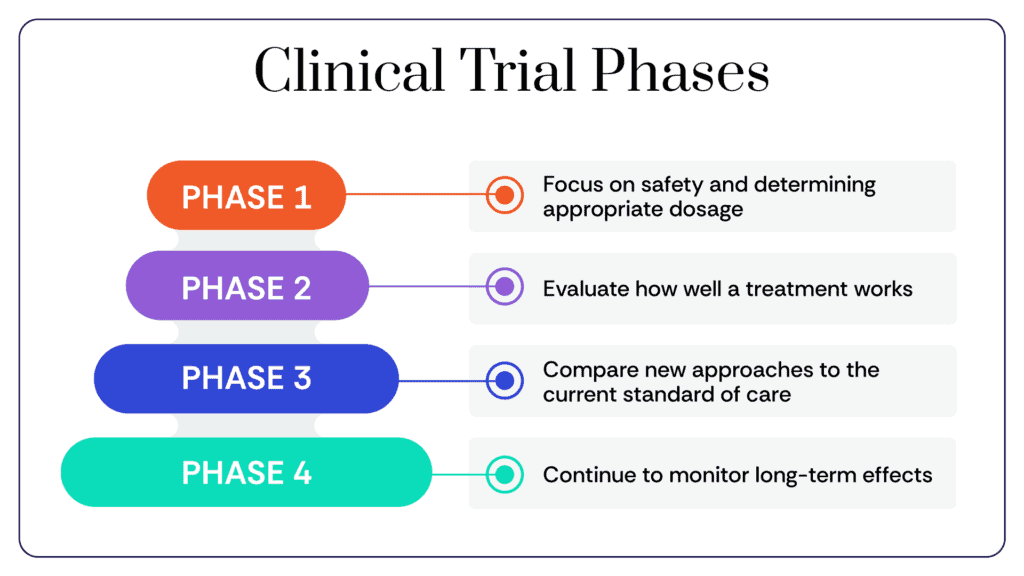
To ensure both patient safety and scientific validity, clinical trials proceed through a series of carefully regulated phases. This sequential process allows researchers to gather incremental knowledge about a new intervention, starting with small groups and gradually expanding to larger populations if initial results are promising. Not all trials advance through every phase, as many are halted due to lack of efficacy or unacceptable toxicity.
- Phase 0: A relatively new phase, involving a very small number of participants (typically 10-15). The goal is to understand how a new drug is absorbed, distributed, metabolized, and excreted by the body (pharmacokinetics) and how it affects the body (pharmacodynamics), often using very low doses to minimize risk.
- Phase I: The first phase to test a new treatment in humans. It involves a small group of people (typically 20-80) to determine the treatment’s safety, optimal dosage, and potential side effects. Researchers closely monitor participants for adverse reactions.
- Phase II: If a treatment proves safe in Phase I, it moves to Phase II, involving a larger group (typically 100-300 participants). The primary goal is to evaluate the treatment’s effectiveness against a specific type of cancer and continue monitoring for side effects.
- Phase III: If Phase II results are promising, the treatment enters Phase III, involving several hundred to several thousand participants. These trials compare the new treatment to the current standard of care or a placebo to confirm its effectiveness, monitor side effects, collect information on long-term safety, and evaluate its overall benefit-risk profile. Successful Phase III trials are typically required for regulatory approval (e.g., by the FDA in the U.S. or EMA in Europe).
- Phase IV: Post-marketing studies conducted after a drug has been approved and is on the market. These trials gather additional information about the drug’s long-term risks, benefits, and optimal use in diverse populations, or to explore new indications for the drug.
This rigorous, multi-stage process, overseen by regulatory bodies and institutional review boards (IRBs) or ethics committees, ensures that treatments are thoroughly vetted before becoming widely available.
The Dual Impact: Benefits for Patients Today and Tomorrow
Participating in a clinical trial offers a unique confluence of potential benefits, both for the individual patient and for the broader scientific community. For many, trials provide access to cutting-edge treatments that are not yet available to the general public, often representing the most advanced therapies developed through years of research. This can be particularly crucial for patients whose cancer has not responded to standard treatments, offering new hope.
Beyond access to novel agents, patients in clinical trials often receive exceptionally close medical monitoring. Specialized care teams frequently track participant health with greater intensity than in standard care, providing a high level of personalized attention and support throughout the treatment journey. This enhanced oversight can lead to earlier detection and management of side effects or complications.
However, the impact extends far beyond individual benefit. As Stage 4 Leukemia Survivor Kristin Kleinhofer articulated, "I began to look at clinical trials, and it wasn’t only that I was fighting for my life, but I really wanted to pay it forward, help cancer research, and help other cancer patients, even if it wasn’t going to work for me." This selfless motivation underscores the collective contribution of trial participants. Every data point, every outcome, every piece of feedback contributes to a growing body of knowledge that will ultimately improve outcomes for countless future patients. It is a profound legacy of hope and progress.
Navigating the Landscape: Practicalities and Support
The decision to explore a clinical trial often begins with an open and honest conversation with one’s doctor. This initial discussion is vital to determine if a trial aligns with the patient’s specific diagnosis, stage, treatment history, and overall health. Factors such as personal goals, preferences, and practical considerations like time commitment, travel requirements, and the availability of support systems must also be weighed.
Support services play a critical role in demystifying this process. Clinical trial navigators are specially trained professionals who guide patients and their families through the complexities of finding, understanding, and enrolling in trials. Resources like CRI’s Clinical Trial Finder also empower patients to explore options with confidence, providing accessible information and pathways to the next steps. Websites such as ClinicalTrials.gov, maintained by the U.S. National Library of Medicine, list tens of thousands of studies and offer a comprehensive, publicly accessible database of clinical research.

Finances are a common concern. While trial sponsors often cover the cost of the experimental treatment and any procedures directly related to the research, routine medical care (like standard doctor visits, hospital stays, or tests that would be part of standard care) is typically billed to the patient’s insurance. It is always advisable for patients to clarify coverage details with their insurance provider and the clinical trial team upfront to avoid unexpected costs.
Eligibility and Ethical Safeguards
Not every clinical trial is suitable for every patient. Each study has specific eligibility criteria, which are strict guidelines based on factors such as cancer type and stage, prior treatments, overall health, age, and sometimes specific biomarkers or genetic features. These criteria are not arbitrary; they are meticulously designed to protect patient safety and ensure that researchers can accurately evaluate the treatment’s effects within a defined population, minimizing confounding variables.
Ethical considerations are paramount in clinical research. All trials are subject to stringent ethical oversight by Institutional Review Boards (IRBs) or Ethics Committees. These independent bodies comprise medical professionals, scientists, and community members who review and approve research protocols to ensure patient rights, safety, and well-being are protected. The process of informed consent is central to this. Before participating, patients receive detailed information about the trial’s purpose, procedures, potential benefits, risks, alternatives, and their right to withdraw at any time without penalty. This ensures that participation is voluntary and based on a full understanding of what the trial entails.
Addressing Misconceptions: Beyond the "Last Resort" Myth
One of the most persistent misconceptions about clinical trials is that they are only for patients who have exhausted all other treatment options – a "last resort." While some trials are designed for advanced-stage cancers or refractory diseases, many others are available at various points along the treatment journey. Depending on the specific diagnosis and treatment plan, a trial might be an option as a first-line therapy, in combination with standard treatments, or as a maintenance therapy. The evolving landscape of cancer research, particularly with the advent of precision medicine and immunotherapy, means that trials are increasingly being integrated into earlier stages of care, offering innovative approaches from the outset. Asking the question early can open doors to new possibilities, as demonstrated by the profound impact on once-terminal cancer patients who found life-changing treatments through trials.
A Path Towards Possibility: The Future of Cancer Care
Clinical trials remain the engine of progress in cancer research, translating scientific hypotheses into tangible improvements in patient care. The continuous evolution of medical science, driven by these trials, promises a future with more effective, less toxic, and highly personalized treatments. Advances in genomic sequencing, artificial intelligence, and sophisticated imaging techniques are further enhancing the design and efficiency of clinical trials, paving the way for even more rapid discoveries.
The collective efforts of researchers, healthcare professionals, patient advocates, and most importantly, the courageous individuals who volunteer for these studies, fuel this progress. As Sharon Belvin, a Stage 4 Melanoma Survivor, powerfully asserts, "Clinical trials are the lifeline for long-term survival rates with cancer. There is no other way to move this field forward, for patients and for everybody else, that would produce any kind of meaningful change. If it wasn’t for clinical trials, I wouldn’t be here." Her testimony encapsulates the transformative power of this research.
Understanding how clinical trials work empowers patients to make informed decisions about their care, regardless of whether they choose to participate. Sometimes, the exploration begins with a single question, and that question can unlock new possibilities, not just for an individual, but for the global fight against cancer.
10 Essential Questions to Ask Your Doctor About Clinical Trials
Engaging in a thorough conversation with your healthcare provider is the crucial first step when considering a clinical trial. Preparing a list of questions can help ensure you feel prepared, confident, and fully informed about your options. You may wish to print these questions as a guide for your appointment.
- Are there any clinical trials that might be right for me?
- Inquire about trials available based on your specific diagnosis, stage, genetic markers, and treatment history.
- What is the goal of this clinical trial?
- Understand whether the trial is testing a new treatment, a combination of therapies, or focusing on other aspects like quality of life or symptom management.
- How does this trial treatment compare to my current or standard treatment options?
- Clarifying the differences can help you weigh whether a trial is the most appropriate path for you.
- What are the possible benefits for me?
- Discuss the specific outcomes researchers are hoping to achieve and what personal advantages you might experience.
- What are the potential risks or side effects?
- Ensure you have a comprehensive understanding of both known side effects and any potential unknowns associated with the experimental treatment.
- What phase is the clinical trial in?
- Knowing whether it’s an early- (Phase I/II) or late-phase (Phase III/IV) trial can provide insight into how much is already known about the treatment’s efficacy and safety profile.
- How long is the trial, and what would participation involve on a day-to-day basis?
- Ask about the estimated time commitment, frequency of visits, required tests, and any travel implications.
- What happens if the treatment doesn’t work for me?
- Understand what alternative options would be available and confirm your right to withdraw from the trial at any point.
- What costs are covered, and what will I or my insurance need to pay?
- Gaining clarity on the financial aspects upfront can help prevent unexpected expenses.
- How will this trial affect my quality of life?
- Discuss potential impacts on your daily routine, including side effects, time demands, and overall lifestyle adjustments.
